blog - Part 103
Categories
Techniques

Didn’t Work?

Set yourself this goal: make 5 to 10 attempts to leave your body upon awakening. This procedure, when followed correctly, is sufficient for 50 to 80 percent of novices to get their first results. Turn back to this section if you run into a problem, as it describes the mistakes encountered in 99% (!) of unsuccessful attempts.

Never try these techniques every day, otherwise the success rate of your attempts will drop drastically! Spend no more than 2 to 3 days of the week on it, preferably only on days off. If you don’t have an opportunity to sleep in long and with interruption, then don’t forget that cycles of indirect techniques can also be used after any other awakening – in the middle of the night for example, or better yet, during a midday nap. What’s most important is to establish the clear intention of trying them before falling asleep.

Despite the simplicity of these techniques, novices stubbornly deviate from the clear instructions, following them in their own way or only half-way. Remember what’s most important beforehand: the more carefully and literally you follow the instructions in this book, the better your chances for success. Ninety percent will obtain results within one to three awakenings if they do everything correctly from the beginning.

Interesting Fact!

At School of Out-of-Body Travel seminars, the main task consists not in explaining the proper procedure, but merely in getting participants to follow it to-the-letter. Even if that goal is only half-way accomplished, success is inevitable.

Typical mistakes when performing indirect techniques include:

– Lack of an attempt to separate

Forgetting to simply try to separate immediately after awakening before cycling techniques, even though this may lead to up to 50% of all experiences. Exception: awakening to movement, after which one may immediately proceed to the techniques.

– Lack of aggression

A desire to get a technique to work no matter what and really get into it is the main criterion for success in employing the indirect technique procedure. Meanwhile, determination should not be superficial, but intensely focused on the actions to be completed. Lack of determination can also manifest itself in passively falling asleep during an attempt.

– Fewer than 4 cycles

No matter what happens and no matter what thoughts occur, you should perform no less than 4 cycles of techniques, assuming none have worked so far. Not following this simple rule will scuttle more than half of your opportunities to enter lucid dreaming.

– Unnecessary Change of Technique

Despite the clear instructions given, novices will stubbornly switch techniques after 3 to 5 seconds, even when a technique has started working in one way or another. This is a serious error. If a technique has started working – however so slightly – you need to keep with it and try to intensify it in any way possible.

– Unnecessary Continuation of a Technique

If a technique hasn’t begun working in the least after 3 to 5 seconds, it should be changed for another. The point of cycling is to quickly alternate between techniques until one of them starts working.

– Forgetting to Separate

When any technique starts working upon awakening – no matter to what degree – the practitioner is nearly always already in lucid dreaming, and is simply lying on his body while in it. That’s why you should always try to separate immediately upon there being stable signs that a technique is working. If that doesn’t work out, then you need to return to intensifying the technique and try to separate again. If you don’t use the first seconds of a technique working, then lucid dreaming usually ends quite quickly and the necessary state goes away. Don’t lie in your body while in lucid dreaming!

– Excessive Analysis

If you analyze what’s going on when cycling through techniques upon awakening, then you are not concentrated on the techniques themselves and are sidetracking yourself. This will cause you to miss nearly all chances of obtaining results. The desire to experience the technique working should fully consume you, leaving no place in the mind for analysis or contemplation.

– Excessively Alert Awakening (no Attempt or a Sluggish One)

Due to the perception of an excessively alert awakening (which will be not actually be alert, but only seem to be from 70 to 90% of the time) the practitioner will either forgo trying anything, or will make attempts quite unassuredly, which is equivalent to not trying at all. You ought to follow the instructions automatically, and not pay attention to such perceptions upon awakening.

– Attempting for Longer than a Minute

If no result is obtained after one minute of cycling, then your odds of success will be much greater if you go back to sleep right away and catch the next awakening in order to make a new attempt, as opposed to stubbornly trying to continue on with the techniques.

– Incomplete Separation

When attempting to separate, sometimes it doesn’t come easily or completely. Sluggishness, stuck body parts, and being stuck in two bodies at once are some things that may occur. Never give up under any circumstances and do not stop separating if this happens. Full separation will occur if you counteract such problems with all your strength.

– Not Recognizing lucid dreaming

Practitioners often enter lucid dreaming but then return back to the body because they feel that what occurred is not what they had expected. For example, when observing images they are often pulled into the scenery, or they are spontaneously thrown into another world when rotating. Practitioners often think that they have to experience the feeling of separation itself, which is why they might return back to their bodies in order to obtain it. The same applies to becoming conscious while dreaming, as the practitioner is already in lucid dreaming and it only remains to deepen and implement his plan of action.

– Awakening to Movement (no Attempt or a Sluggish One)

Awakening without moving is desirable, but not mandatory. There’s no sense in forgoing most opportunities by waiting for the right awakening. You must take advantage of every awakening that you can.

– Wasting the First Seconds

Try to develop the habit of immediately and reflexively proceeding to the techniques upon awakening, without losing a second. The more time that elapses between awakening and the attempt itself, the lower the odds of success. It’s best to learn to catch not so much the very second of awakening, but rather the transitional moment when “surfacing” from sleep. Separation is almost always successful during that transitional moment.

– Selection of Same-Type Techniques

There’s no point in selecting techniques for your practice that are similar to one another or focused on the same sensation (when using techniques from other parts of this book).

– Use of a Single Technique

Cycling indirect techniques upon awakening is a universal method that can work for anybody provided they alternate several techniques. Completely different methods may work over different attempts. That’s why using only a single technique upon awakening instead of cycling through at least two leads to substantially lowered odds of entering lucid dreaming.

– False Physical Movement

Sometimes separation is so indistinguishable from ordinary physical movement that novices are unable to believe their own success. They perceive separation as a physical movement and then disappointedly lie back down into their body. In such cases, one ought to carefully evaluate the situation and possibly perform reality checks.
Categories
Techniques

A Journey into Outer Space

My body was still very tired, even though I had already been able to sleep for several hours that night. As soon as I lay down, I almost immediately felt vibrations occurring, but was not relaxed enough to bring them up to full force. At the moment, the best way to relax and enter lucid dreaming seemed to me to be through "trans-awakening" (the free-floating state of mind). I turned out to be right, as after the fifth or sixth time I felt intense vibrations enveloping me from all sides. In this case, there was no need to amplify the vibrations or deepen lucid dreaming, as my body was tired, and it would create a most deep state all on its own in order to more quickly restore its vital energies. I just lay for some time and observed the changes occurring within me. However, I could not remain idle for long, lest I unintentionally fall asleep.

I spent some time on fixing my secondary attention on avoiding falling asleep and involuntary exit from lucid dreaming. I rolled out. As usual, I rolled out of the bed as if for real, but not hitting the floor. Instead, I hovered above the floor as if I had fallen on a one-foot high invisible air mattress. I have rolled out hundreds of times, but I always experience doubt in the back of my mind that I am actually falling out of bed in reality.

A multitude of ideas flashed through my mind on how to use this position. I immediately formulated an approximate plan of action, which included those senseless things that I save for a rainy day. However, I first decided for the umpteenth time to observe outer space scenes. I took up my goal: the Cosmos. Here I was immediately picked up by a mysterious force that whisked me away at breakneck speed. My vision quickly came back to me, and I found myself floating in an unknown part of the Cosmos. I don’t know how true-to-life the sensations were, as I have never been in outer space. Nonetheless, I probably experienced it just like it would be in real life. Sight was the predominate sense here, I stopped paying attention to the other four. Taking in the galaxy within my field of view brought fantastic pleasure. The unusualness in the visual perception consisted in the uncommon way that my eyes had to focus, as we rarely use our eyes in that way in real life. Taking in the galaxy required my eyes to fully uncross and look at the sight in parallel. The galaxy seemed as if it were alive, and I said to myself that this was probably the most beautiful thing that I had ever seen.

However, I couldn’t stay there for long, as there was nothing to concentrate my sense of sight on, because the objects were very far away. I returned to the void, and, suspended in a static position, created strong vibrations. For a while, I simply enjoyed this uncommon sensation. It was interesting to observe the characteristics of this phenomenon. When I raised my arms and brought my palms towards my face, I felt strong, warm wind streaming from them to my face. Noise filled my ears. When I palpated my head with my hands, it seemed as if I was touching my unprotected brain, but there was no pain.

I enjoyed this state for some time, plunging in some unknown direction. After a short flight, I was ejected back into my room at home. This time everything in it corresponded 100% to reality, enough though I had not set myself that goal. Nothing interested me in the room, and so I walked through my bedroom door into the other rooms, with everything as in real life. I didn’t have to look long for adventure, as I found my mother and brother in the other room, both of whom I had not seen for a while. I spoke with them about anything that came to mind, just for the sake of hearing their voices and getting a chance to look at them. This was a real gift for me. But I faded out a bit, and was only able with great difficulty to regain control over the state through the infamous technique of falling head-first …

Categories
Techniques

Step 2: Go Back to Sleep with an Intention

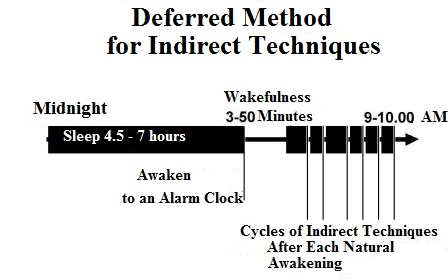
After 3 to 50 minutes of being awake, go back to bed and concentrate your attention on how you will perform cycles of indirect techniques upon each subsequent awakening in order to leave your body and implement your prepared plan of action. No need to set the alarm clock this time. Each subsequent awakening should occur naturally. If it’s too bright in the room, you can wear a special eye-mask. If it’s loud – use earplugs.

Meanwhile, focus your attention on how you’re going to try to wake up without moving your physical body. This isn’t mandatory, but it will substantially increase the effectiveness of the indirect techniques.

Now, sleep for 2 to 4 hours, but take advantage of natural awakenings that occur during this period of time. They will happen much more often than usual. After each attempt – whether successful or not – you must fall back asleep with that very same intention of waking up and trying again. In this way, you can make many attempts over the course of a single morning. Up to a quarter of those attempts will be successful, even for novices (70 to 95% of them will be successful for experienced practitioners).

Categories
Techniques

Plan of Action in lucid dreaming

Before entering lucid dreaming, you should clearly outline what you are going to do there immediately after separation. This will increase both the quality of the experience and the likelihood of it occurring. Below is a list of the most interesting (if not the most straightforward) lucid dreaming activities for novices (choose no more than 2 to 3 activities and remember them well):

Look in a mirror (a must for the first lucid dreaming!)

Eat or drink something you like

Visit any tourist attraction

Fly over the Earth

Fly throughout the Universe

Fly to neighbors, friends, and family

Meet a lover

Meet a deceased relative

Meet any celebrity

Take medicine for treatment

Obtain information from lucid dreaming objects

Travel to the past or the future

Walk through a wall

Transmutate into an animal

Drive a sports car

Ride a motorcycle

Breathe underwater

Put your hand inside your body

Feel vibrations

Inhabit two bodies at once

Inhabit another person’s body

Move and set fire to objects just by looking at them

Drink liquor

Make love and reach orgasm

For your first lucid dreaming, be sure to set yourself the goal of making it to a mirror and looking at your reflection. You should specifically program yourself to do this activity, as it will substantially facilitate your first steps in conquering lucid dreaming. You may then complete other items on your plan of action and never return to the mirror again.

If your sensations in lucid dreaming are dull (i.e. poor sight or numbed bodily sensations), try to touch everything around you actively and scrutinize the minute details of objects from up-close. This will allow you to have a more realistic experience. The same activities should be performed in order to maintain lucid dreaming when the first symptoms of a return to the body occur (for example, when everything becomes dim).

Returning to the body is something you needn’t worry about. The state will not last more than several minutes in any case, especially for novices who are little-acquainted with techniques for maintaining lucid dreaming.

Categories
Techniques

Evaldas 2

Lithuania

I was on my one-and-a-half week dry spell and I was not trying to get into lucid dreaming. But I broke my dry spell by becoming conscious within a dream. Once I understood that I was in lucid dreaming, I immediately tried to do deepening, but I failed and got thrown back into my body. Refusing to surrender, I somehow managed to reenter my lucid dreaming – YAY! So, after successfully reentering my lucid dreaming, I performed deepening and throughout all of lucid dreaming I did maintaining.

My plan was to talk with my subconscious and ask for my talents and a quick way to earn money. After summoning my dream character to talk with me, I started the conversation. It was a very strange conversation, because she kept asking non-related things which I can’t remember. After finally asking the question I had wanted to ask, she answered, “Eating”. She said this and nothing more after that. That’s when my lucid dreaming ended (M.R.: no maintaining and re-entering), after about 10 minutes of being in it.

Our posts


Staying Awake in Dreams?

ES | PT | FR | DR | IT | ND | CN | JP | KR | RU | UA | PL | BL | CZ | TH | VN | TR | AR | PR | RM | HU | IL | AM | GR Lucid Dreaming and REM sleep technologies Love lucid dreaming, REM sleep, and sleep paralysis? Here, we share cool tech and methods with you Our new mask Lucid Dream Tonight? A perfect […]

MORE

REMspace Forecast for 2026: Top 10 Dream Abilities We May Gain This Year

At REMspace, we believe that 2026 will mark a turning point for sleep technologies. According to our CEO, Michael Raduga, a new era is emerging – one that opens an entirely new experiential space within sleep

MORE

LucidMe Mask Reviews | Real Lucid Dreaming Experiences

People using the LucidMe mask say it really helps them notice when they’re dreaming. Many describe clear signals, sudden moments of lucidity, and vivid dream experiences — flying, meeting people, exploring strange places. Not every attempt works, and sometimes lucidity fades fast, but users feel the mask pushes them closer to stable lucid dreams. It’s […]

MORE

The Indirect Method: Step-by-Step Instructions

Lucid Dreaming Mask — Practice Effectively Lucid Dreaming App — Dream Journal, Dream Tracker & Lucid Dreaming Community So, you have decided to experience out-of-body sensations and want to achieve this as quickly as possible. To that end, here we present a brief description of the easiest method – cycles of indirect techniques. This is […]

MORE

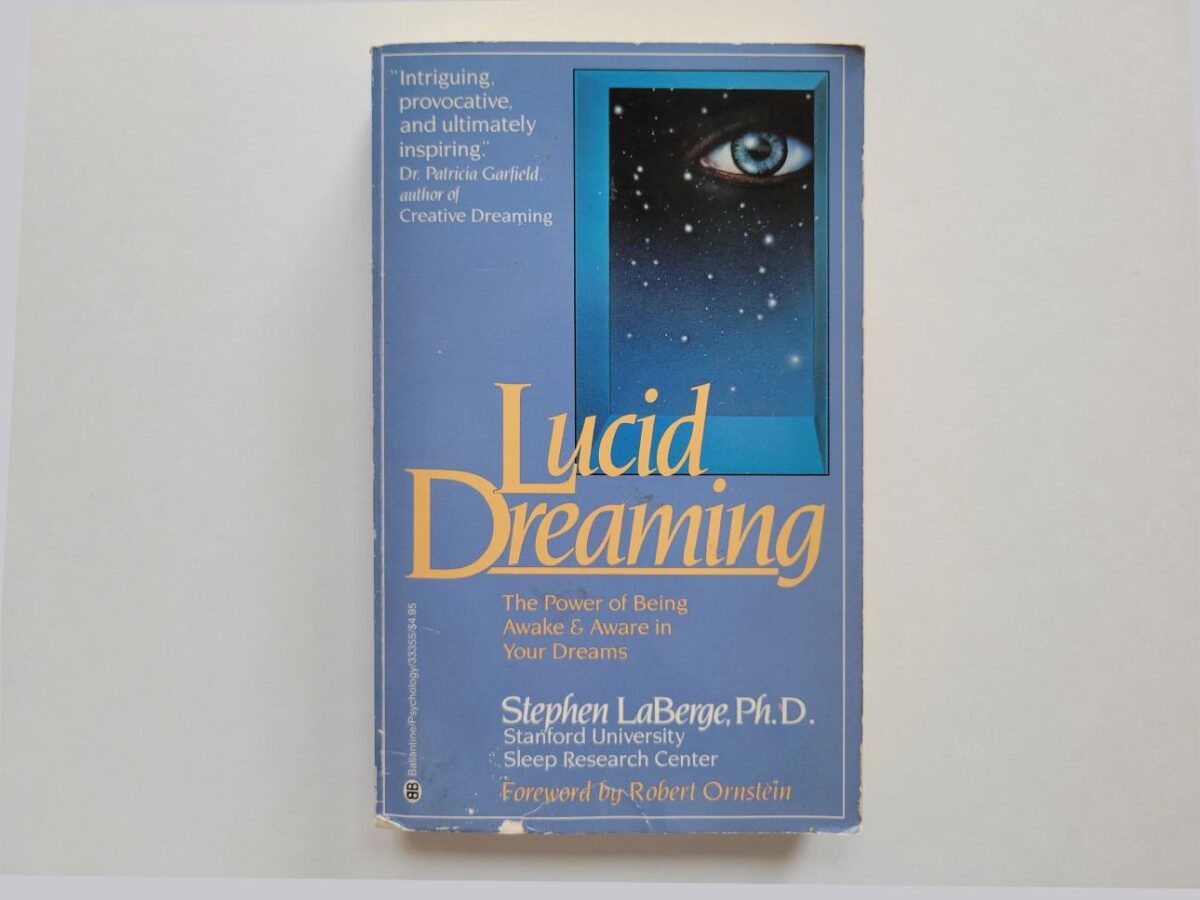
Lucid Dreaming Book by Stephen LaBerge

Lucid Dreaming Mask — Practice Effectively Lucid Dreaming App — Dream Journal, Dream Tracker & Lucid Dreaming Community The mystery of lucid dreams is hidden deep within human consciousness. Questions about their origin have been pondered by hundreds of people, including distinguished scientists. Therefore, it would be a mistake to assume that this topic is […]

MORE

Stephen LaBerge and Lucid Dreaming

Lucid Dreaming Mask — Practice Effectively Lucid Dreaming App — Dream Journal, Dream Tracker & Lucid Dreaming Community Dreams are an area that captivates many people. Even if only unintentionally, every second person has asked themselves, “What do my dreams mean?” Scientists are no exception to this. Lucid dreaming — a state during which a […]

MORE

The Art of Dreaming – Carlos Castaneda

Lucid Dreaming Mask — Practice Effectively Lucid Dreaming App — Dream Journal, Dream Tracker & Lucid Dreaming Community History provides many outstanding names, and Carlos Castaneda has firmly taken his place among them. His personality is full of mysteries, and his philosophy and worldview are multifaceted. The books he wrote, such as “The Art of […]

MORE

Robert Monroe: “Journeys Out of the Body” and Lucid Dreaming

Lucid Dreaming Mask — Practice Effectively Lucid Dreaming App — Dream Journal, Dream Tracker & Lucid Dreaming Community Robert Monroe was an engineer by profession who worked as a scriptwriter and director for radio stations. He later founded his own radio station, which, under his leadership, achieved tremendous success in a short time. Starting in […]

MORE

Lucid Dreaming Movies – Top 20 Most Popular Movies

Lucid Dreaming Mask — Practice Effectively Lucid Dreaming App — Dream Journal, Dream Tracker & Lucid Dreaming Community There are more films about lucid dreaming than you might think. Some fully explore the concept, while others just touch upon it. Experienced lucid dreamers have compiled a list of films that, although often classified as science […]

MORE

Transmitting Music from Lucid Dreams

This is how we transmitted a simple melody from lucid dreams about a year and a half ago. The paper has been published recently. Next year, anyone will be able to find brilliant melodies in lucid dreams and then record or even stream them online. Join the waiting list for the device Details about the […]

MORE

Two-way control of a virtual avatar from lucid dreams

Lucid Dreaming Mask — Practice Effectively Lucid Dreaming App — Dream Journal, Dream Tracker & Lucid Dreaming Community Researchers at REMspace have achieved the first two-way control of a virtual object from a lucid dream. The results of the experiment were approved for publication in the scientific journal International Journal of Dream Research.

MORE
Other news
😴 LucidMe — lucid dreaming mask