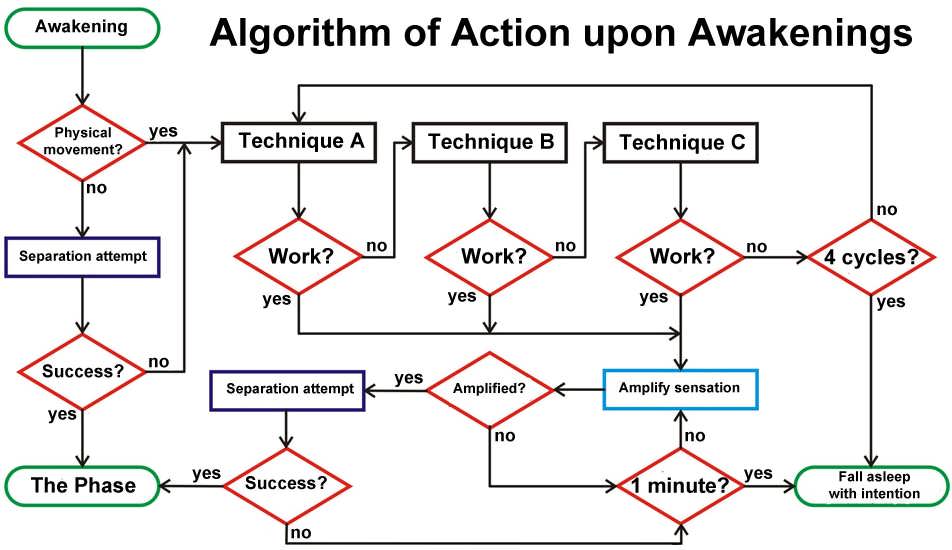
If the first cycle of 3 techniques does not yield any clear results, this does not mean that all is lost. Even if the techniques do not work, they still draw the practitioner closer to lucid dreaming state and it is simply necessary to continue using the techniques by again observing images, phantom wiggling, and listening in – and repeating this process at least three times.
Having performed one cycle of techniques, one can easily go on to doing a second cycle, a third one, a fourth one, and so on. It is quite probable that during one of these cycles, a technique will suddenly prove itself, even though it had not been working at all just a few seconds beforehand.
A serious practitioner should commit to a minimum of 4 cycles. The problem lies in the fact that it is psychologically difficult to do something that has shown itself not to work, and one may give up taking further action, even though one could be at the cusp of falling into lucid dreaming. Keep trying, and then try again, and again! There have been cases where it took ten cycles to produce results. A monumental effort, yes, but one worth the outcome. But don’t do it for more than one minute.
The key to practice is the quantity and quality of attempts made that hone a practitioner’s skills. There are several windows of time best suited for employing indirect techniques.
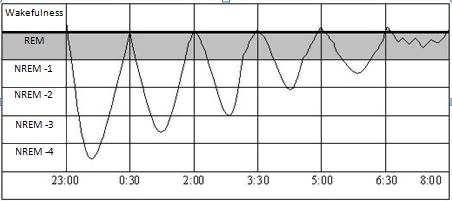
To begin, it should be stated that sleep follows a cyclical pattern. We awaken every hour-and-a-half and then quickly fall asleep again, which gives rise to sleep cycles. Furthermore, we experience two primary stages of sleep: rapid eye movement (REM) sleep, and non-rapid eye movement (NREM) sleep. NREM sleep includes many internal stages. The more we sleep, the less the body needs deep NREM sleep, and the more time we spend in REM sleep. lucid dreaming entrance is most likely to occur during REM sleep.
The best way to implement indirect techniques is by the deferred method. The aim of the method is to interrupt a sleep cycle during its final stage and then disrupt it again after falling back to sleep, which makes sleep light during the rest of the sleep cycle. Sleep accompanied by frequent interruptions can be put to productive uses.
Interesting Fact!
When the deferred method was first made mandatory at a 3-day School of Out-of-Body Travel seminar in June 2008, the overall success rate immediately doubled.
For example, if a practitioner (let’s call him Jack) goes to sleep at midnight, then Jack should set an alarm for 6 o’clock in the morning. Upon awakening, Jack should engage in some sort of physical activity, like going to the bathroom, getting a drink of water, or reading a few pages of this book. Afterward, Jack should go back to bed thinking about how, within the next two to four hours, he will wake up multiple times and make an attempt to enter lucid dreaming during each awakening.
If Jack goes to bed earlier, then his alarm clock should be set back by that amount of time, since six hours of initial sleep is the optimal length of time. If Jack sleeps less than six hours, then the second half of his night’s sleep will be too deep. If Jack sleeps longer than six hours, then there will be little time remaining for attempts, or Jack may not even be able to fall asleep.
If a practitioner naturally wakes up in a forceful manner, it will be difficult to regain sleep. Thus, it will not be necessary for the practitioner to get out of bed with the aid of an alarm. The practitioner should attempt to go right back to sleep.
If a practitioner is able to fall back asleep after as much as 45 minutes of being awake, then it’s better to keep to that very interval, as it allows one to obtain the highest probability of success during subsequent awakenings.
Naturally, the deferred method is most applicable in cases where it is possible to sleep as long as a practitioner desires, without having to wake up early. Not everyone enjoys such luxury on a daily basis, but nearly everyone has days off when time may be set aside to practice the deferred method. It is in large measure due to the deferred method that classroom courses at the School of Out-of-Body Travel allow up to 2/3 of class participants to enter lucid dreaming in the course of a single weekend!
The second most effective window of time for entering lucid dreaming is ordinary morning awakening. This generally occurs during light slumber following a full night’s sleep.
Another effective time to practice indirect techniques is after awakening from a daytime nap. Once again, this type of sleep will be light and short, which provides the body needed rest while allowing memory and intention to be kept intact through the moment of awakening. Again, not everyone has the luxury of taking daytime naps, but if such a chance arises, then it would be very beneficial to take advantage of the opportunity.
Nighttime awakenings are the least effective times for lucid dreaming experimentation because the brain still requires a lot of deep sleep at this time. Awakening at night, the mind is quite weak and hardly capable of any effort. Even if some results are observed, awakening often ends with quickly falling back asleep. This is not to say that normal practice of lucid dreaming cannot occur at night; it just won’t be as effective as at other times. The nighttime option is best for those who lack an opportunity to use other windows of time for practicing lucid dreaming.
Understand that we awaken at night every 90 minutes, which is why a minimum of four awakenings is almost guaranteed when sleeping, even for just six hours. When the practitioner knows about this and strives to seize those moments, with time he will actually seize them and take advantage of them.
Always remember that a typical lucid dreaming experience consists of several repeated entries and exits. Essentially, in most cases it is possible to re-enter lucid dreaming through the use of separation or lucid dreaming state creation techniques immediately after returning to the body. If the practitioner has just left lucid dreaming, the brain is still close to it and appropriate techniques may be applied in order to continue the journey.
When I was about 17 or 18 years old, I read some esoteric articles on astral projection. They seemed quite interesting to me, but no more than a curiosity – I did not particularly believe in such things.
One evening, I went to bed as usual. I woke up in the middle of the night, but was unable to move my body and there was a loud noise in my head. Having been reminded of those articles, I simply tried to levitate and I managed to do so, as if through my forehead somehow. The sensation of flying was very realistic, to my great surprise. The first thought that occurred to me was, "Wow, these astral guys weren’t lying!” I hovered above my body for some time in the dark. I thought of vision, and it started to appear. I then flew towards the window, and upon turning around in to face my body (M.R.: no deepening and no plan of action), I saw it in its proper place. I decided to fly back to it and touch it. When I finally poked it, it sucked my back into it, causing a quite strange sensation (M.R.: no maintaining and no re-entering).
Perhaps the only thing that an advanced practitioner might still have to struggle with is maintaining lucid dreaming. However, it’s only a struggle in a relative sense, and more of a struggle for perfection. An essential way that an experienced lucid dreamingr differs from a novice is that the length of time that he stays in lucid dreaming is fully sufficient for his needs. No matter how long he stays in lucid dreaming, this duration is multiplied by his many lucid dreaming entrances over the course of even a single day. As a result, he always accomplishes all of the tasks he has set for himself, and often quite quickly. And if a practitioner accomplishes all his objectives, why should he be dissatisfied with the duration of a lucid dream?
The first sign of an advanced practitioner is that he always has a plan of action for lucid dreaming. An interesting and useful one. He always knows what he will do in lucid dreaming and how he will apply it. He always wants to enter lucid dreaming, as he always has many things to do in it, even if they sometimes have nothing to do with the physical world. Moreover, many advanced practitioners undertake their own studies of lucid dreaming, which serves to further stimulate their own practice and personal development.
The main problem novices have in maintaining lucid dreaming paradoxically consists in fear of a foul, i.e. an involuntary return to the body. This usually causes them to perform the maintaining techniques incorrectly, and they nearly always lack the intention of maintaining, not to mention confidence in their own abilities. But this is a decisive factor when it comes to maintaining lucid dreaming.
A novice performs maintaining techniques in order to not be returned back to the body or not fall asleep, while an experienced practitioner performs maintaining techniques in order to maintain his presence in lucid dreaming.
As a result, the former is often soundly thrown out of lucid dreaming, while the latter has experiences that are many times longer and more relaxed. Even thinking of one’s own body while in lucid dreaming is fraught with the danger of returning to it, to say nothing of techniques which are focused on the conscious ability to reenter the body.
While in lucid dreaming and when performing any maintaining technique, a practitioner should be extremely confident that he will be in lucid dreaming for just as long as he needs to be. Such confidence alone is sufficient to substantially prolong the average lucid dreaming.
However, when maintaining lucid dreaming, advanced practitioners have to face the real issue of keeping their minds out of their bodies – and this means false fouls. The absolute majority of returns to the body from lucid dreaming are false. Depending on one’s personal characteristics and level of practice, from 50 to 90% of all returns to the body can be false. That’s precisely why the mandatory rule is: upon returning to the body, one must try to separate from it again. Even when following this rule, the experience nonetheless often ends in a false awakening that is only recognized some time after the fact.
The problem is partially resolved by understanding that a return to the body from lucid dreaming means nothing at all. If it happens, it’s but a trifle for one’s practice not worthy of the slightest attention. If you were just in lucid dreaming, then it can’t end so easily or quickly. An experienced practitioner should always (always!) try to re-enter lucid dreaming and do it with as much self-assurance as possible. And if one is at last unable to leave the body again, then one must perform at least two reality checks (hyperconcentration, breathing out through a pinched nose, looking for inconsistencies, etc.), as there is a high likelihood that one is still nevertheless in lucid dreaming. Reality checks alone can prolong a lucid dream experience by up to 20 percent. In summary, at higher levels of practice, a lucid dreamr must try to re-exit his body. If he is unable to, then he must perform reality checks.
There are several reasons why practically all practitioners have such problems with false returns to the body. One of the main ones is a certain lack of confidence in one’s own powers when maintaining lucid dreaming, which is remedied by intensifying one’s intention and concentration. However, there is also a certain problem that is practically resistant to controllable solution and is brought about by the astounding characteristics of human consciousness during altered states: false memory.
Sometimes, a cluster of false memories – yet quite detailed and emotionally-charged ones – will suddenly appear in a lucid dreamr’s memory during a lucid dream experience. This indicates that he has long been in lucid dreaming, and thus quite a psychologically accepting state. As a result, a lucid dreamr may not put up much resistance to a foul, or even control the foul himself. As soon as he returns to the body, he’ll realize that lucid dreaming was actually much shorter than it seemed to his mind. Sometimes only a detailed analysis can uncover this uncommon problem and bring the practitioner to understand that he was not in lucid dreaming for the seeming 5 minutes, but merely 10 seconds. The prescription for this strange trick of the human mind is nevertheless the same: mandatory re-exits from the body no matter what it seems or what one thinks, and if this is unsuccessful – reality checks.
ES | PT | FR | DR | IT | ND | CN | JP | KR | RU | UA | PL | BL | CZ | TH | VN | TR | AR | PR | RM | HU | IL | AM | GR Lucid Dreaming and REM sleep technologies Love lucid dreaming, REM sleep, and sleep paralysis? Here, we share cool tech and methods with you Our new mask Lucid Dream Tonight? A perfect […]
At REMspace, we believe that 2026 will mark a turning point for sleep technologies. According to our CEO, Michael Raduga, a new era is emerging – one that opens an entirely new experiential space within sleep
People using the LucidMe mask say it really helps them notice when they’re dreaming. Many describe clear signals, sudden moments of lucidity, and vivid dream experiences — flying, meeting people, exploring strange places. Not every attempt works, and sometimes lucidity fades fast, but users feel the mask pushes them closer to stable lucid dreams. It’s […]
Lucid Dreaming Mask — Practice Effectively Lucid Dreaming App — Dream Journal, Dream Tracker & Lucid Dreaming Community So, you have decided to experience out-of-body sensations and want to achieve this as quickly as possible. To that end, here we present a brief description of the easiest method – cycles of indirect techniques. This is […]
Lucid Dreaming Mask — Practice Effectively Lucid Dreaming App — Dream Journal, Dream Tracker & Lucid Dreaming Community The mystery of lucid dreams is hidden deep within human consciousness. Questions about their origin have been pondered by hundreds of people, including distinguished scientists. Therefore, it would be a mistake to assume that this topic is […]
Lucid Dreaming Mask — Practice Effectively Lucid Dreaming App — Dream Journal, Dream Tracker & Lucid Dreaming Community Dreams are an area that captivates many people. Even if only unintentionally, every second person has asked themselves, “What do my dreams mean?” Scientists are no exception to this. Lucid dreaming — a state during which a […]
Lucid Dreaming Mask — Practice Effectively Lucid Dreaming App — Dream Journal, Dream Tracker & Lucid Dreaming Community History provides many outstanding names, and Carlos Castaneda has firmly taken his place among them. His personality is full of mysteries, and his philosophy and worldview are multifaceted. The books he wrote, such as “The Art of […]
Lucid Dreaming Mask — Practice Effectively Lucid Dreaming App — Dream Journal, Dream Tracker & Lucid Dreaming Community Robert Monroe was an engineer by profession who worked as a scriptwriter and director for radio stations. He later founded his own radio station, which, under his leadership, achieved tremendous success in a short time. Starting in […]
Lucid Dreaming Mask — Practice Effectively Lucid Dreaming App — Dream Journal, Dream Tracker & Lucid Dreaming Community There are more films about lucid dreaming than you might think. Some fully explore the concept, while others just touch upon it. Experienced lucid dreamers have compiled a list of films that, although often classified as science […]
This is how we transmitted a simple melody from lucid dreams about a year and a half ago. The paper has been published recently. Next year, anyone will be able to find brilliant melodies in lucid dreams and then record or even stream them online. Join the waiting list for the device Details about the […]