At REMspace, we believe that 2026 will mark a turning point for sleep technologies. According to our CEO, Michael Raduga, a new era is emerging – one that opens an entirely new experiential space within sleep
In recent years, sleep tech has evolved far beyond simple trackers and wearable sensors. Humanity is moving from passively recording sleep to actively shaping it: we are improving deep rest, reducing nighttime awakenings, detecting stress patterns in real time, and even interacting with the dreaming mind. As AI, neuroscience and biometric monitoring converge, we are learning more about sleep, and we can now influence and optimize it in ways that were impossible just a decade ago.
The rapid progress in sleep science has inspired a global wave of new research and experimentation. Among these efforts are our studies on dream interaction, including research confirming the first communication between sleeping individuals and demonstrations in which participants used lucid dreaming to control a virtual car. As more discoveries are made, experts anticipate that, in 2026, a new generation of sleep technologies will reach consumers, introducing capabilities that once existed only in theory.
Ten of the most compelling possibilities
1. Dream Sharing
In 2026, advanced multi-sensor sleep devices will allow people to share far more than just sleep stages. Through mobile apps, users will be able to exchange information about the emotional tone of their dreams, overall dream style, activity levels, sociability inside dreams, and other qualitative markers. This means you will finally be able to understand what your friends and family actually experienced during the night, turning dreaming into a new shared experience. This concept has already been hinted at by early apps such as our own LucidMe.
2. Internet-Connected Dreams
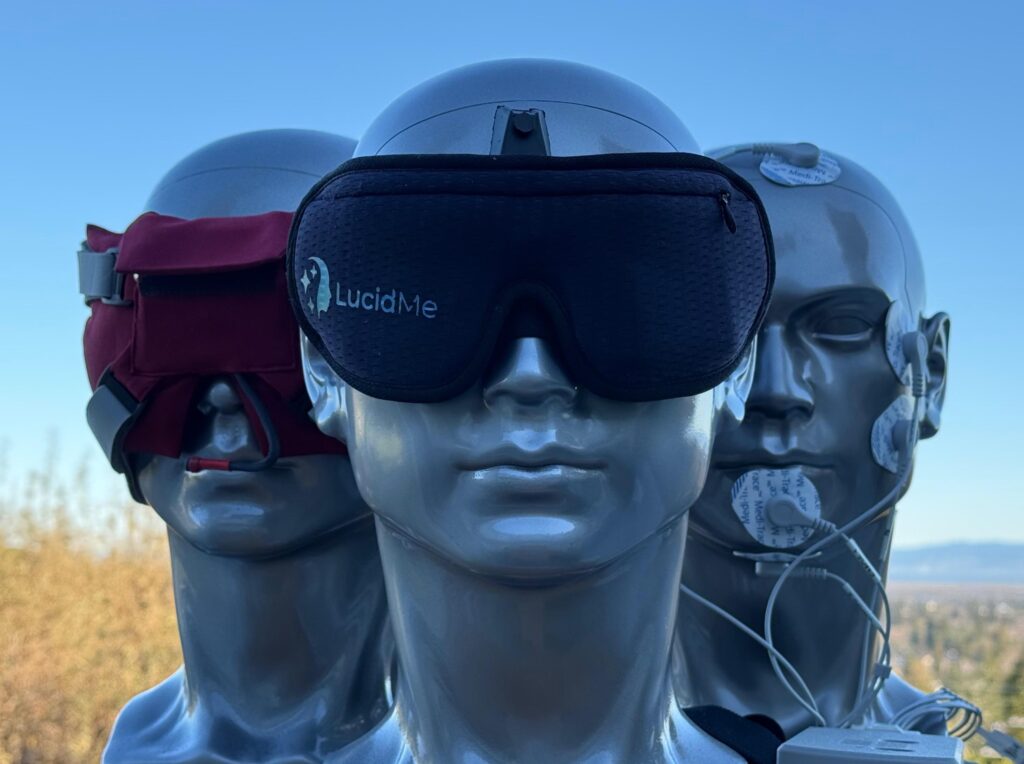
Smart sleep masks will stream real-time brainwave data to cloud servers that can interact with the sleeper through light and sound stimulation. These systems will help solve common sleep problems, optimize dream experiences, and allow limited forms of connection between dreams and online services. Early capabilities will be basic, but these are just the first steps toward a new technological era in which dreams will be linked to the digital world.
3. Dream Modulation
A new wave of mobile apps and AI-powered sleep masks will allow people to influence dream narratives, helping people enter specific dream locations or meet certain individuals. This means users could intentionally dream about traveling through space or reconnecting with long-lost loved ones. Although this field has been researched for decades, modern AI and sensor technologies will finally make dream modulation accessible to the general public.
4. Deep Sleep Enhancement
AI-driven sleep devices will dramatically improve the quality of deep sleep. Nearly half of all people suffer from insomnia or low-quality sleep, and traditional solutions have reached their limits. New technologies will help users to fall asleep faster, stabilize sleep cycles, and extend deep sleep phases, resulting in more restorative rest and better overall well-being. One example of how this is achieved is SomnoAI, developed at REMspace, which integrates into the LucidMe Pro sleep mask and enables these improvements through real-time adaptation to the user’s sleep patterns.
5. Synchronized Dreaming
Dream synchronization will allow multiple people to experience coordinated dream themes. Thanks to dream-modulation technologies and cloud connectivity, friends may dream about similar scenarios—such as visiting a tropical island—and discuss the shared experience the next day. This synchronization could occur not only sequentially but also simultaneously, creating a new kind of collective dream space.
6. Dream Visualization
Scientists are already using multi-channel electroencephalography (EEG) and AI to reconstruct simplified versions of what a person sees while they sleep. Though these reconstructions are still crude, they are real. In 2026, the first consumer-oriented dream-visualization devices may appear, offering either sophisticated but expensive tools or simpler, more affordable ones with lower accuracy. In any case, this will be the first step toward publicly accessible dream imaging.
7. Lucid Dream Hacking
More than half of people experience at least one lucid dream in their lifetime; these dreams arise when a person realizes they are dreaming during REM sleep. Until now, achieving lucid dreams has typically required extensive practice and training. This is something LucidMe Pro also addresses, continuously monitoring cognitive and physiological signals during REM sleep and delivering precisely timed stimuli that guide users into lucidity-making lucid dreaming effortless and accessible.
8. Dream Communication
In 2026, regular users will be able to send basic dream signals to one another, including signals from one person’s lucid dream into another person’s lucid or non-lucid dream. Early implementations will be rudimentary, but the technology could evolve into multi-user dream communication, including group chats between dreamers.
9. Nightmare Management
This will help people who struggle with chronic nightmares, particularly those experiencing insomnia, PTSD, anxiety, or depression. To give an example application, if the device detects distress during a dream, it will shift the storyline to a calmer scenario until physiological indicators stabilize.
10. Universal Dream Recall
Around 20% of people report rarely remembering their dreams, even though everyone dreams every night. The issue lies in how the brain stores dream memories. AI-powered sleep masks will enhance dream recall by applying sensory stimulation during REM sleep and at the edge of awakening, improving memory consolidation. As a result, nearly everyone will be able to remember multiple vivid dreams each night, transforming sleep into a consistently rich and immersive experience.
If progress continues at its current rate, 2026 will be a landmark year for sleep technology. Tools that once existed only as scientific prototypes or speculative ideas are nearing the point of consumer availability. While challenges related to privacy and accessibility, for example, continue, the trajectory is clear: sleep science is entering a transformative era. Whether they use sleep tech for their health, creativity, or curiosity, people will soon have more control over their dreams than ever before, driven in part by ongoing work at REMspace.