Most of the time, falling asleep while in lucid dreaming can be overcome by a constant awareness that sleep is possible and detrimental to a continued lucid dreaming. A practitioner must always consider the probability of falling asleep and actions must be carefully analyzed to ensure that they are based on real desires and not on the paradoxical notions common to dreams.
Categories
Bo
Antwerp, Belgium
I entered lucid dreaming this morning. More or less like the previous times, only this time I rolled deliberately over to the other side of the bed. I came down on the floor, which became visible when I opened my eyes.
I touched the sheets. Everything turned very real and I thought to myself, “where am I” because I was so overwhelmed by the vividness.
The light was dim and I asked for more light but it didn’t change. The room was a combination of our room now and my room when I was a child.
I pinched my nose and blocked my airways but I could breathe normal. I stood up and went to the door (M.R.: no plan of action). I opened it. It was dark outside. Then I saw that there was a drawing on the outside of the door. It was a little figure and when I looked more closely it began to move his head.
I wanted to touch it, but I felt paralyzed. My arms felt very heavy. Once I had almost touched it, I woke up (M.R.: no re-entering).
Categories
Finding by Transmutation
This technique distorts lucid dreaming space while not completely disengaging a perception of the space. The practitioner must give strong attention to a thought that a required object is going to appear in a desired location. There must be sufficient confidence that the practitioner’s desires will be realized. At this moment, the process of metamorphosis will begin: space will distort and dim, and the required object will begin to manifest itself. After this, brightness and focus will be restored with necessary alterations made present in lucid dreaming space.
This technique is relatively difficult to perform in comparison to others, and, therefore, it is better to use it only after a high level of experience has been reached, as it is difficult to remain in lucid dreaming during any metamorphic process.
As is evident in the name of this technique, it can be used to find objects and also create new objects from found objects.
Categories
A Long Way for a Short lucid dreaming
I woke up sometime at about 9 am, and my first thought was that I had woken up too alertly to do anything with lucid dreaming. As always, I forced myself to still try to do something. The awakening was so alert that it was somewhat difficult to convince myself to this end. The situation was aggravated by physical movement – I was lying down uncomfortably on my stomach.
I immediately performed forced falling asleep for a few seconds, causing me to feel a sharp plunge in my mental state, as if I were retreating deep into myself. I tried to separate right then, but nothing happened: neither levitation, nor rolling out, nor getting up. I started performing one of my favorite techniques: phantom wiggling. No movement arose. A few seconds later, I tried visualizing my hands. Then observing images. There was no result, but I noted that my hearing was fading out: I already couldn’t clearly hear sounds coming from outside the window or the room. That definitely meant something. I again tried phantom wiggling, but nothing happened after several seconds of trying.
I decided to do visualization of the hands together with forced falling asleep. I started waving my hands in front of my face, and then rubbing may palms together, trying to distinguish all this visually. Meanwhile, I feel into a deeper state, leading my conscious awareness into the void. It was right then that I noticed that I sensed my hands to be less under the pillow, and more in front of my face. Once my conscious awareness got distracted by this, everything stopped right then and there. I again began to fade out, and then tried to feel and see my hands in front of me. With my remaining remnants of awareness, I began to notice that my hands’ presence in front of my face was increasingly palpable, and I even began to be able to make them out visually. As soon as I realized that I could see them, I reactivated my conscious awareness, and started trying to discern the hands as clearly as possible. And after a couple of seconds, they became as clearly visible as they would be in reality. Now I could feel them 100%, and even forgot about where they were lying in reality. Not more than 30 seconds had elapsed so far from the moment of initial awakening.
After that, I just got up off the bed, quickly mentally running over my plan of action. But then, the telephone lying on the floor next to the bed unexpectedly started ringing. I picked it up, and could feel not only its physical features, but even how it vibrated out the ring-tone. My colleague from work flashed on the caller ID. I wondered what he would say to me in lucid dreaming, and so I pressed the button to take the call. To my surprise, the phone kept on ringing. I became confused. I again pressed the button to take the call, but to no end. I realized that the phone was probably also ringing in reality.
As soon as that realization hit me, I was instantly back in my body. The phone was really ringing. And indeed, it was my colleague from work calling. The question remains as to why that sound didn’t immediately knock me out of lucid dreaming. Perhaps because lucid dreaming space was overlapping the real world in a completely logical way.
The term lucid dreaming state (or simply lucid dreaming) encompasses a number of widely known dissociative phenomena, many of which are referred to by various terms, such as astral travel or out-of-body experience. This concept also includes the more pragmatic term lucid dreaming, but is not limited to the sense and form implied by that expression. Hence, the term lucid dreaming has been introduced to ease the study of phenomena that exist beyond habitual – and often inaccurate – associations and stereotypes. The term out-of-body experience is accurate to the extent that it describes the sensation felt by a person experiencing lucid dreaming phenomenon.
a lucid dream has two primary attributes: 1.) practitioners possess full, conscious awareness during the experience, and 2.) practitioners recognize a genuine separation from the physical body.
Simultaneously, the degree to which practitioners perceive lucid dreaming environment affects the level of sensory experiences therein, which often occur in a higher form than the sensory experiences of wakefulness. This concept is difficult to imagine without firsthand experience of lucid dreaming. And so, it is not without reason that this practice is considered to be a higher state of self-hypnosis or meditation, and is often referred to under different names as the highest possible human achievement in various religious and mystical movements (yoga, Buddhism, etc.).
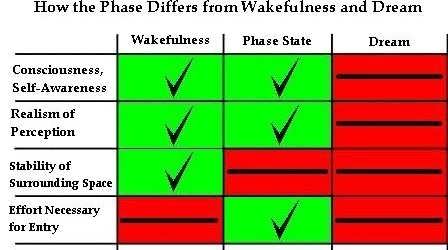
In essence, lucid dreaming is an unexplored state of mind where one is unable to control or feel the physical body. Instead, space perception is filled with realistic phantom experiences.
Interesting Fact!
Sensations in lucid dreaming state can be so realistic that practitioners who unintentionally enter it often believe they are still in the physical body, and that the experience is occurring in the waking state. These types of unintended excursions most often occur at night or early in the morning.
It is believed that one person in two on this planet will encounter this phenomenon at least once in his life. However, when the variability and differing levels of depth of the state are taken into consideration, practically everyone has encountered it in one way or another. Since lucid dreaming is a rare subject of study, many who inadvertently enter it do not realize what has taken place once they return to wakefulness. Many do not assign any significance to the occurrence of a lucid dream environment that is not fully formed because shallow lucid dreams don’t leave the same jolting impression as deep states. Elusive as lucid dreaming may seem, this is an extremely common phenomenon, accessible to anyone willing to consciously learn and apply the correct methods of achieving and maintaining it.
Interesting Fact!
9 and 75 year-olds have studied at School of Out-of-Body Travel seminars. Meanwhile, even as many trouble themselves over the issue of how much age hinders or helps in the practice, these people demonstrated some of best results in their groups.
Even a scientific approach to the phenomenon states unequivocally that lucid dreaming is accessible to all, barring serious brain pathologies. This has been unambiguously confirmed by experimental research. Therefore, there’s no sense in reasoning that lucid dreaming is something difficult, accessible only to a small circle of people, or out of anyone’s reach. Difficulties in mastering it attest only to technique-related mistakes, and not to the inaccessibility of the phenomenon.